


Floating Stones and Empty Space: What a Tech Professional Taught Me About Letting Go

We live in a world obsessed with stacking. More output, tighter deadlines, optimized metrics, and flawless execution. We stack our days, our calendars, and our expectations until there is barely any air left between the blocks.
Yesterday evening, someone looking for a deliberate break from that busy tech world walked straight through the doors of the studio.
An adult student—a brilliant professional working in the high-octane AI tech industry—joined one of our painting sessions simply because they wanted to step away from their daily routine and try acrylic painting. They hadn’t come in search of a masterclass or a career credential; they just wanted a quiet, analog space to work with their hands and unplug for a few hours.
They selected a meditative, zen-inspired landscape featuring stacked stones—a classic study in balance and grounding.
As they began working on the canvas, I watched them settle into the rhythm of mixing paints and sweeping the brush across the surface. But then, something wonderful and unexpected happened. Instead of meticulously stacking the rocks on top of each other according to the composition's traditional rules, they paused, made a quiet creative pivot, and decided to let the stones float independently. They kept the entire composition wonderfully, breathably minimalistic.
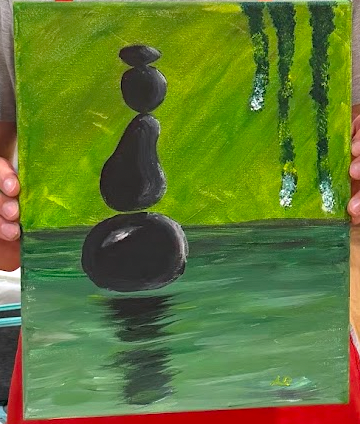
For someone navigating a hyper-engineered, hyper-optimized daily environment where every move is calculated and every problem must be solved with a rigid formula, that simple act of creative autonomy was profound. They gave themselves permission to break the visual rules, leave empty space on the canvas, and let things float rather than force them into alignment.
When they finally stepped back and looked at what their own hands had created, the shift in the room was palpable. The momentum of the workday had melted away, replaced by a quiet sense of ownership and peace. They looked at the canvas and said that this piece wasn't going into a closet or a stack—it was going straight onto their living room wall as a daily anchor.
Driving home that evening, I couldn't stop thinking about that session.
We often talk about art as a wellness tool in abstract terms, but moments like this make it so tangible. Modern professionals—whether they are writing code, managing teams, or building the future of artificial intelligence—are profoundly starved for analog spaces where they don't have to perform. They need spaces where it is safe to make a stray mark, let go of perfection, and discover what happens when you leave a little empty space on the canvas of life.
Art doesn't ask you to optimize. It simply asks you to breathe, pick up the brush, and let the stones float.


Comments